EEICAT and related studies
The EEICAT paper, the typology of ecological impacts on which it is based, and a related study on expert perceptions of impact types.
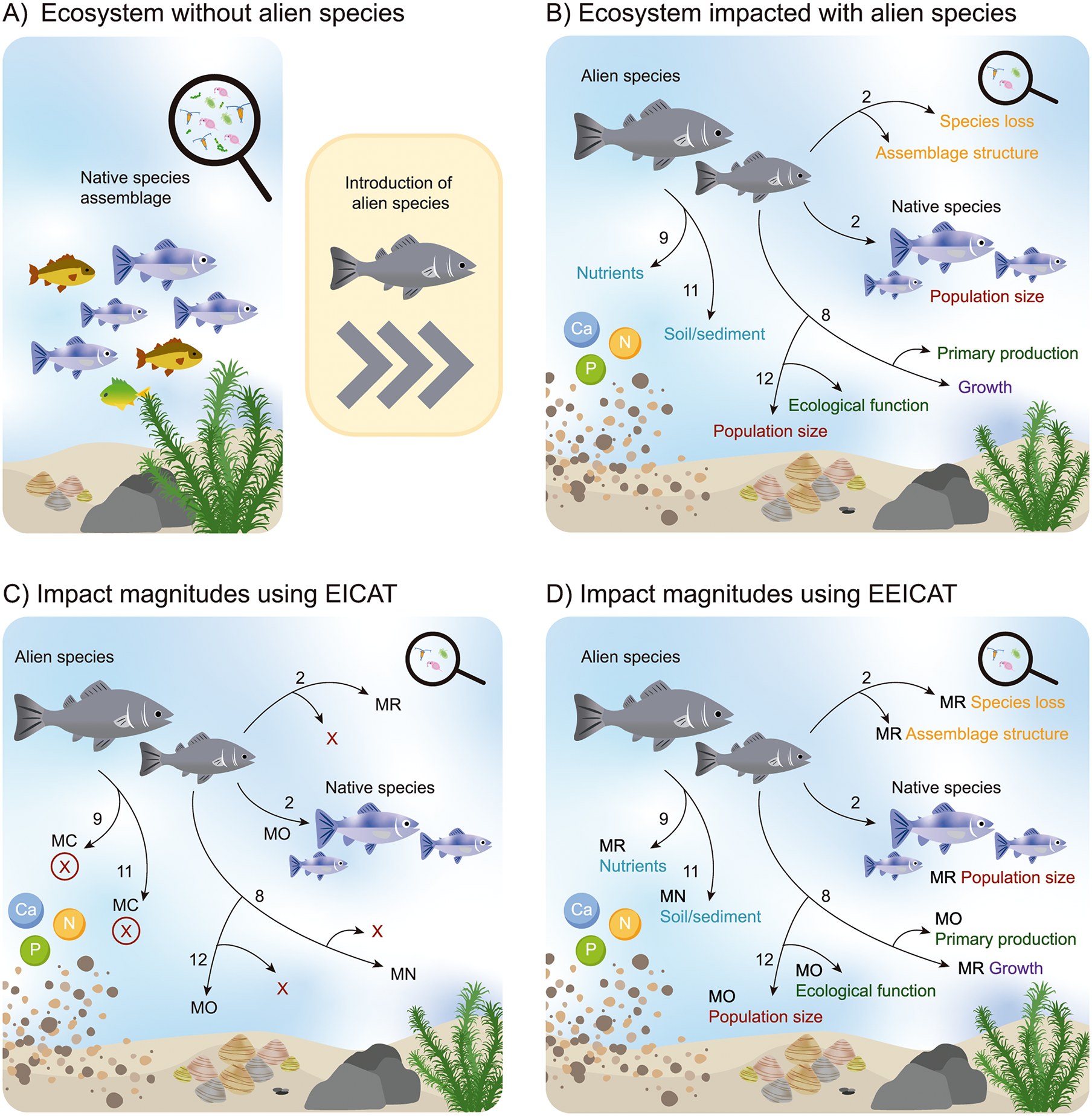
Carneiro, L., Pincheira-Donoso, D., Leroy, B., Bertolino, S., Camacho-Cervantes, M., Cuthbert, R. N., Bang, A., Catford, J. A., South, J., Cooke, S. J., Angulo, E., & Courchamp, F.
(2026). PLOS Biology 24(3), e3003665.
Introduces the Extended EICAT (EEICAT), which classifies 19 impact types across three ecological dimensions and shifts the unit of assessment from the species to the invasion event. Open access.
Carneiro, L., Leroy, B., Capinha, C., Bradshaw, C. J. A., Bertolino, S., Catford, J. A., et al.
(2025). Trends in Ecology & Evolution 40(6), 563–574.
Proposes a typology of 19 ecological impact types and distinguishes impact mechanisms from the impacts they cause.
Carneiro, L., Caetano, G. O., Wang, S., Arbieu, U., Catford, J. A., Courchamp, F.
(2026). PLOS ONE 21(8), e0351775.
Survey of more than 400 invasion scientists on the relative importance of each ecological impact type.
Biological invasions: global context
Global assessments and syntheses on the extent, ecological consequences and economic costs of biological invasions.
IPBES
(2023). Roy, H. E., Pauchard, A., Stoett, P., & Renard Truong, T. (eds.). IPBES secretariat, Bonn, Germany.
Global assessment of the status, trends, impacts and management of invasive alien species. A condensed version is available in the Summary for Policymakers.
IPBES
(2019). IPBES secretariat, Bonn, Germany.
Identifies invasive alien species as one of the five main direct drivers of change in nature.
Pyšek, P., Hulme, P. E., Simberloff, D., Bacher, S., Blackburn, T. M., et al.
(2020). Biological Reviews 95(6), 1511–1534.
Review of the impacts of invasive alien species on biodiversity, ecosystem functioning and human livelihoods, and of the measures needed to reduce them.
Doherty, T. S., Glen, A. S., Nimmo, D. G., Ritchie, E. G., & Dickman, C. R.
(2016). Proceedings of the National Academy of Sciences 113(40), 11261–11265.
Quantifies the contribution of invasive mammalian predators to global extinctions and current threats to birds, mammals and reptiles.
Bellard, C., Genovesi, P., & Jeschke, J. M.
(2016). Proceedings of the Royal Society B 283, 20152454.
Global analysis of the vertebrate groups and regions most threatened by biological invasions.
Diagne, C., Leroy, B., Vaissière, A.-C., Gozlan, R. E., Roiz, D., Jarić, I., et al.
(2021). Nature 592, 571–576.
Global estimate of the economic costs of biological invasions, based on the InvaCost database.
The EICAT framework
Development and implementation of the IUCN Environmental Impact Classification for Alien Taxa.
IUCN
(2020). First edition. IUCN, Gland, Switzerland.
IUCN standard defining the EICAT impact categories, mechanisms and classification criteria.
Blackburn, T. M., Essl, F., Evans, T., Hulme, P. E., Jeschke, J. M., Kühn, I., et al.
(2014). PLOS Biology 12(5), e1001850.
Original proposal of the classification scheme, with five semi-quantitative impact levels from Minimal to Massive, analogous to the IUCN Red List approach.
Hawkins, C. L., Bacher, S., Essl, F., Hulme, P. E., Jeschke, J. M., Kühn, I., et al.
(2015). Diversity and Distributions 21(11), 1360–1363.
Framework and guidelines for the consistent application of EICAT, including the treatment of uncertainty and the documentation required.
Impact measurement and terminology
Syntheses of how invasion impacts are measured and reported, and of the terminology used in invasion science.
Crystal-Ornelas, R., & Lockwood, J. L.
(2020). Biological Invasions 22, 1513–1525.
Assessment of which impacts of invasive species are measured and reported, and of the resulting gaps in impact evidence.
Stevenson, E. A., et al.
(2023). Biological Invasions.
Bibliometric synthesis of 35 years of research on invasive non-native species.
Soto, I., Balzani, P., Carneiro, L., Cuthbert, R. N., et al.
(2024). Biological Reviews 99(4), 1357–1390.
Review of terminology in invasion science and proposal of a standardised framework, translated into 28 languages.
Ecological literature, text mining and artificial intelligence
Bibliometric analyses of ecological research and applications of large language models to evidence synthesis and data extraction from the scientific literature.
McCallen, E., et al.
(2019). Frontiers in Ecology and the Environment 17(2), 109–116.
Analysis of shifts in research themes in ecology over four decades.
Castagneyrol, B., Bedessem, B., & Julliard, R.
(2023). Ecology and Evolution 13, e10488.
Bibliometric comparison of ecological research conducted with and without citizen scientists.
Berger-Tal, O., et al.
(2024). Trends in Ecology & Evolution 39(6), 548–557.
Review of the opportunities and risks of artificial intelligence in conservation evidence synthesis, with recommendations for its use.
Gougherty, A. V., & Clipp, H. L.
(2024). npj Biodiversity 3, 13.
Comparison of LLM-based and manual extraction of ecological data from the literature, in terms of speed and accuracy.
Castro, A., Pinto, J., Reino, L., Pipek, P., & Capinha, C.
(2024). Ecological Informatics 82, 102742.
Evaluation of GPT-3.5, GPT-4 and LLaMA-2 for identifying, extracting, geocoding and structuring species distribution data from news reports and research articles.
Scheepens, D., Millard, J., Farrell, M., & Newbold, T.
(2024). Methods in Ecology and Evolution 15(7), 1261–1273.
Application of LLMs to the screening and classification of literature on potential natural enemies of agricultural pests.
Keck, F., et al.
(2025). bioRxiv (preprint).
Large-scale extraction of species interactions from more than 80,000 scientific articles using LLMs. Preprint.
Books
Reference texts on invasion ecology, from introductory to advanced.
Invasive Species: What Everyone Needs to Know
Simberloff, D.
(2013). Oxford University Press, Oxford.
Introductory overview of biological invasions, their impacts and their management, for a general readership.
Lockwood, J. L., Hoopes, M. F., & Marchetti, M. P.
(2013). Wiley-Blackwell.
Textbook covering the invasion process from transport and establishment to impacts and management. Chapters 9 and 10 address ecological impacts.
Elton, C. S. (with contributions by D. Simberloff & A. Ricciardi)
(2020). Springer, Cham. First published 1958.
Annotated edition of the 1958 monograph regarded as the foundation of invasion ecology, including previously unpublished notes by the author.